

Supply and installation
Hychem makes the system and an approved applicator lays it — a single workshop bay or a landmark project, in every state. One specification, one quote, and the manufacturer behind the floor.
How it works
Four steps from the first call to a floor in service — with the people who make the product behind every one.
-
Tell us the site
Where it is, what the floor has to handle, the area, and when it has to be done.
-
We specify the system
Our technical team recommends the build-up and writes the specification.
-
An approved applicator quotes
We match your site to an experienced Hychem applicator in your state.
-
Laid, and backed by Hychem
Product, data sheets and technical support come from the people who make it.
Approved applicators
A national network, 30 years in the making
Every Hychem approved applicator is trained on the systems they lay and has years in resin flooring. That experience is what lets them take on the difficult jobs — live food plants, overnight kitchen refits, car park decks over occupied space — and finish on time.
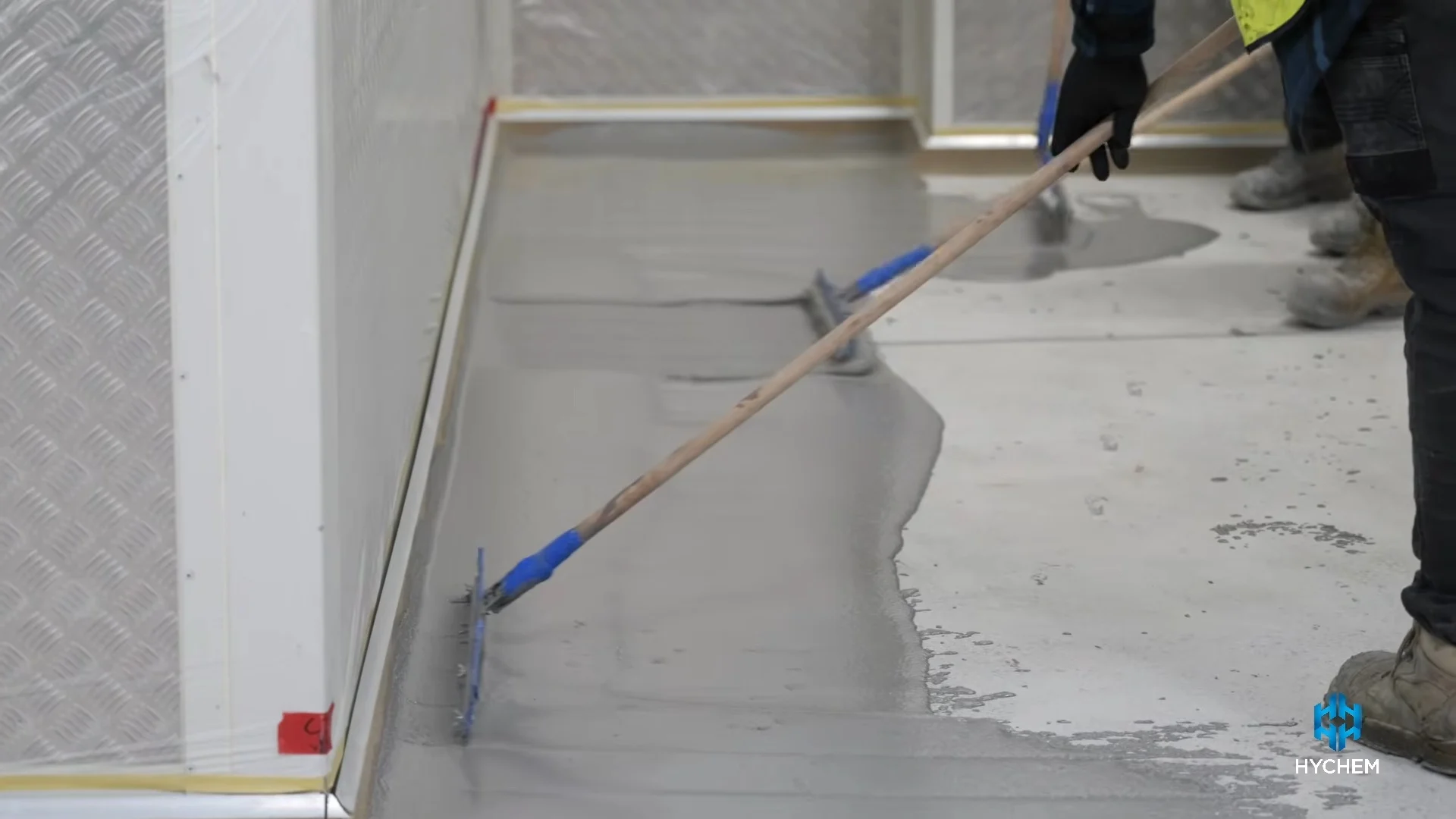
We have developed a strong national network of contractors over the past 30 years, so we always have local solutions for installation. Our contractors are ready to take on new projects in all cities and all states.
Chris BauerHychem Flooring
Our offices
Talk to the office in your state — they know the local applicators, the conditions and the projects nearby.
-
Sydney
Head office and manufacturing — NSW
Unit 1, 30 Bluett Drive
Smeaton Grange NSW 2567 -
Melbourne
Victoria
51 Atlantic Drive
Keysborough VIC 3173 -
Brisbane
Queensland
405 Newman Rd
Geebung QLD 4034 -
WA · SA · TAS
Chris Bauer — Flooring Director
What goes into the price
The system and its thickness set most of the cost. For a price on your floor, ask for a quote.
-
The system and its thickness
A sealer, a coating, a topping or a membrane: different material, different labour.
-
Preparation
Grinding or shot blasting, repairs, and levelling a worn slab.
-
Area
Small jobs cost more per square metre than large ones.
-
Access and hours
Night or weekend work around a live site.
-
Downtime
How soon the floor must be back in use decides the chemistry.
-
Details
Coving, drains, joints and upstands.
How the systems compare
| System | Typical thickness | Typical use | Back in service (at 25 °C unless noted) |
|---|---|---|---|
| Clear sealer — WE70, PU100 | Thin film | Car parks, warehouses, retail | Foot traffic in 24 hours (PU100) |
| Epoxy coating — Supafloor, SF20 | 300 microns to 1 mm | Warehouses, workshops, schools | Foot traffic in 24 hours, full cure in 7 days |
| Self-levelling epoxy — SL20 | 2–4 mm | Pharmaceutical plants, labs, hospitals | Foot traffic in 24 hours, full cure in 7 days |
| Polyurethane cement — Hycrete PU-SL | 4–9 mm | Food processing, cold stores, kitchens | Foot traffic in 12–20 hours, heavy traffic in 2 days |
| MMA — Polyac | 1–5 mm | Fast turnarounds, cold rooms, decks | Walkable in 1 hour (20 °C) |
| Trafficable membrane — Deckproof PU-2-SL | Membrane under a wearing course | Car park decks, balconies, stadiums | Set by the wearing course |
FAQs
Can't see your question? Call us or send it — a technical person replies, usually the same business day.
Do you take on small jobs?
Yes. Our applicators lay floors from a single workshop bay to landmark projects. Tell us the size and we match the right team.
Do you install outside Sydney?
Yes. Hychem has offices in Sydney, Melbourne and Brisbane, a representative for Western Australia, South Australia and Tasmania, and approved applicators in every state.
Can my own contractor lay a Hychem system?
Yes. We supply trained applicators across Australia, and your contractor gets the data sheets, specification and technical support from us.
How long will the floor be out of use?
From about an hour for MMA to a few days before heavy traffic on polyurethane cement. The table above gives each system’s times; we plan the work around yours.
Do you write the specification?
Yes. Tell us the environment and the timing, and we recommend the system and write the specification.
Specification service
Get the floor priced and laid.
Tell us the site, the area and the timing.