
Warehouse and manufacturing flooring
Warehouse and manufacturing floors take forklifts, pallet jacks and racking, and they have to stay clean and dust-free. Hycrete polyurethane cement and E300SL self-levelling epoxy carry heavy production traffic; SupaFloor, PA315 and PA330 coat general areas with colour and line marking.
What the floor has to handle
- Traffic
- forklifts, pallet jacks, racking point loads
- Dust
- untreated concrete dusts under wheels
- Markings
- aisles and safety walkways
- Downtime
- large areas done in stages around operations
- Heavy Duty Industrial SolutionsHychem Hycrete PU-SLPolyurethane concrete flooring systemView system Data sheetFast cureFood safeSlip resistant
- Heavy Duty Industrial SolutionsHychem Hycrete TCTopcoat for polyurethane concreteView system Data sheetChemical resistantLow temperature cureLow VOC
- Heavy Duty Industrial SolutionsHychem E300SLEpoxy binder for epoxy floor toppingsView system Data sheetChemical resistant
- Concrete Sealers and CoatingsHychem E100Solvent-based, two-component epoxy primer for concreteView system Data sheet
- Concrete Sealers and CoatingsHychem SupaFloorMulti-Purpose Pigmented Epoxy Flooring SystemView system Data sheetChemical resistant
- Concrete Sealers and CoatingsHychem PA315High gloss, pigmented polyasparticView system Data sheetChemical resistantFast cureGreen Star
- Concrete Sealers and CoatingsHychem PA330Polyaspartic coloured floor coating with UV colour stabilityView system Data sheetUV stable
- Decorative Flooring and OverlaysHychem Hy-FlakeA decorative, medium duty epoxy floor topping with good colour stabilityView system Data sheetSlip resistant
Also suits every industry
Standards that apply
| Standard | Title | What it means for the floor |
|---|---|---|
| AS 4586-2013 | Slip resistance classification of new pedestrian surface materials | Classes a new floor: P0–P5 on the wet pendulum, R9–R13 on the oil-wet ramp, A–C for wet barefoot areas. Ask for the class the area needs, not just "non-slip". |
| Green Star | Green Building Council of Australia rating tools | Low-VOC floor products contribute to the indoor-environment credits; WE70 and WE90 are compliant with Green Star Interiors VOC limits. |
Which product holds which certificate: certifications and approvals.
Specified on
Bosch Rexroth
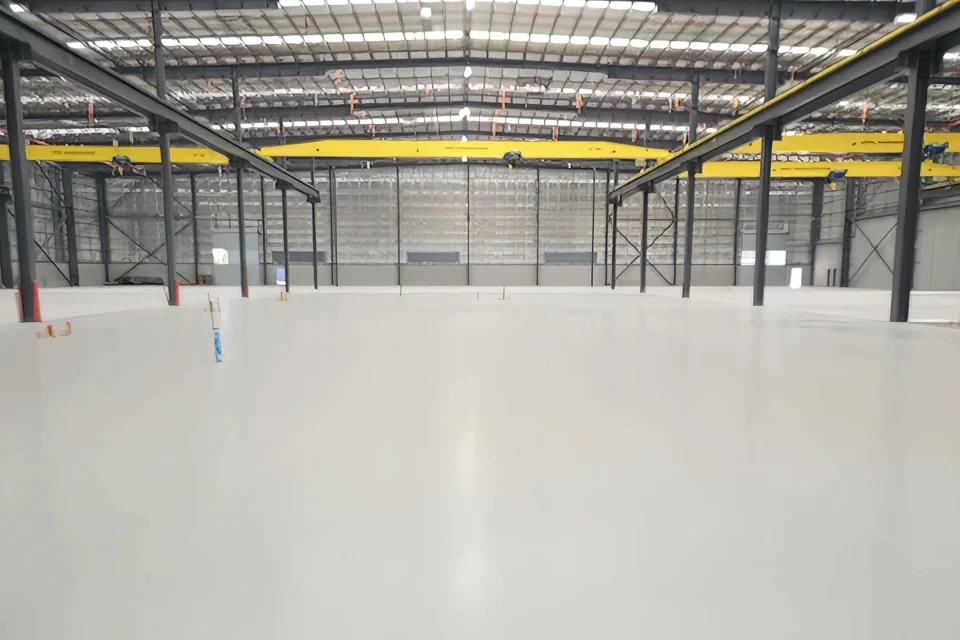
Bosch Rexroth chose Hychem again for its new 8,000 m² facility, more than ten years after the first: self-levelling epoxy with a slip-resistant topcoat.
FAQs about warehouse and manufacturing flooring
Densifier or epoxy for a warehouse?
A densifier such as Hardenseal keeps a ground or polished slab dust-free without a surface film. Epoxy adds colour, markings and chemical resistance, and hides a worn slab.
What is the best epoxy for a warehouse?
Supafloor for general areas, SL20 self-levelling where heavy loads and a smooth, easy-clean floor are needed, SF25 where low odour matters.
Guides to read next
Taking the shock out of flooring
Warehouse storage racking is an essential component in the modern logistics industry but it is not without its risks.
The odds are stacked against PVC
“Many of the by-products of the PVC lifecycle are now ubiquitous global pollutants, which can be found not only in industrialised regions but in the planet’s most remote ecosystems.
Reducing slip hazards in the workplace
Short answer: specify the slip-resistance class the area needs under AS 4586, build it into the floor with an anti-slip texture, and clean the floor so the texture keeps working.


Specification service
Specifying for this environment?
Tell us the floor, what happens on it and when it needs to be down.
or call 1300 HYCHEM